

Prof Lothar Schermelleh

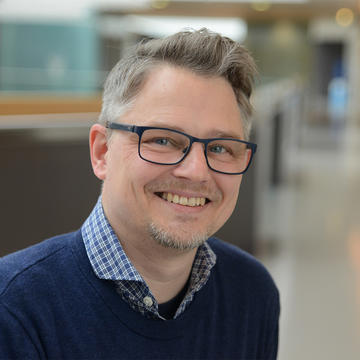
Prof Lothar Schermelleh
Advanced cellular imaging to study nuclear organisation and dynamics
Lothar’s research focuses on understanding how three-dimensional nuclear organisation influences genome function in mammalian cells. His work integrates genetic approaches with cutting-edge optical imaging to explore how spatial genome architecture regulates activity.
As an early member of the Micron Advanced Bioimaging Unit and now Director of the Micron Bioimaging Facility (micronoxford.com), he has contributed to the development of computational analysis methods and fluorescence labelling strategies for super-resolution microscopy, enabling increasingly precise visualisation and quantification of subcellular structure and dynamics.
His current research programme investigates how biophysical forces, epigenetic memory, and cohesin complex activity interact to shape cell–type–specific transcriptional programmes during differentiation and in pathological cellular contexts.
To address these questions, his group combines genome editing and cell-biological manipulation with advanced live-cell and complementary super-resolution imaging approaches, ultimately aiming to directly visualise and investigate fundamental genome processes such as RNA transcription and DNA replication within their native nuclear environment at nanoscale resolution.

